ANTON U3A QUESTERS
REPORT ON VISIT TO SUMMERDOWN FARM, nr OAKLEY
THURSDAY 13 July 2023
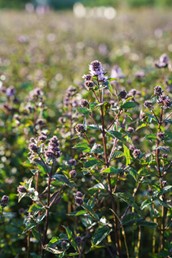
A group of 25 Questers visited the Summerdown Farm, near Oakley just outside Basingstoke (RG23 7EY) on Thursday 13 July 2023.
Summerdown are the peppermint people. Black Mitcham peppermint has been grown on the farm for nearly 30 years after being reintroduced into England by Sir Michael Colman in 1995. The overwhelming intense flavour of this variety of peppermint makes it stand out as a high-quality product. The farm has over 100 acres of English peppermint under cultivation and produces the world’s purest peppermint oil. This is used in the manufacture of a wide range of high-quality products including bath essences, home fragrances, teas & oils and of course mint chocolates. They also grow chamomile and spearmint and from these they extract oils as well as manufacture teas and the like.
This was a self-drive outing so all Questers arrived at the Summerdown Clubhouse at or shortly after 10:15 ready for the introduction talk by Laura who was our host. Laura was accompanied by her daughter Lily and colleague Angie. We were given a H & S briefing before we were ready to set out on the tour to explore their operations.
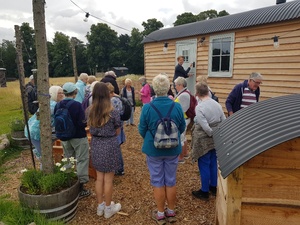
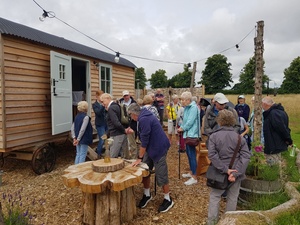
Our first stop was to see the newly established shepherd’s huts of which 5 have been established around the perimeter of a rewilded field that had previously been a cricket field. The huts are individually designed and made by local craftsmen using traditional techniques and locally sourced timber. The huts are fitted out internally with luxurious facilities to house two people with a double bed, kitchen, dining area and ablution facilities. Locally designed and produced outdoor furniture with bbq are set up in front of each unit. These will make fantastic accommodation for two people.
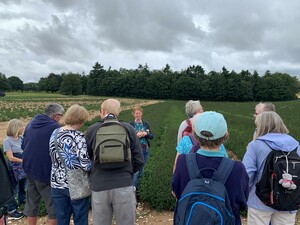
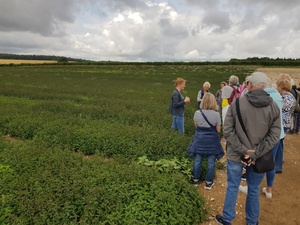
We then continued our tour to go to the fields where the Black Mitchem peppermint is grown. The plants looked in good condition and growing strongly. They were judged to be about 2 – 3 weeks before harvesting. No irrigation is used on these fields and so they rely solely on rainfall for moisture. Members had lots of questions about the cultivation of the peppermint plants, all derived from the original plant material brought back from USA by Sir Michael Colman in the early 1990’s. Once the plants are harvested they are left to lie in the fields for a day or so to start to dry out. The crop is then loaded into large mobile bins and these are transported to the distillery for further processing.
From the cultivation fields we then moved to the distillery where the various herbs are processed to extract their oils. Rosie, the distillery operator explained the process used, which is essentially the same for all three crops. The large mobile bins are connected to the installed piping and steam is fed into the bin. This steam then causes the oils in the plant material to vaporise and flow with the steam into a condenser which cools the steam and separates out the oil and water fractions. The oil is then collected in containers for storage before being used in the various product manufacturing processes. The water is collected and reused to reduce overall water consumption.
We were also shown samples of the oils of the various herbs as well as dried and processed versions of them. The colour of some of them was surprising – chamomile which is a small white flower with a yellow centre and green foliage produces a dark blue oil. Peppermint with a very small purple flower and dark green foliage produces a light amber coloured oil! Once again the Questers had lots of questions which Rosie answered admirably.
With the tour completed we returned to the Clubhouse for a sandwich platter and snack lunch which was very well received by all of us. After lunch we had the opportunity to buy, at discounted prices, a wide selection of Summerdown products. Many members made good use of this opportunity too.
The hospitality of Laura and her team as well as the information provided by Rosie and others was excellent and really much appreciated by us all. There have been many positive comments from those on the outing some even several days later.
Our grateful thanks to Farm Manager Ian, Laura, Angie, Rosie and Lily for an excellent visit.
Cecil Rose